Cool!
Then we aren’t arguing!
Cool!
Then we aren’t arguing!
Hey @NotoriousToker, just to be clear, I like what you do, I like what you stand for.
I do.
I wish nothing but the best for you.
Simpler times in some ways  Love to see that. Appreciate it man.
Yup.
It’s all good with me.
Already said what I needed to say.
I hope you did too.
Take care!
When casting longer lines I have found it helpful to to cast from the shoulder (not elbow + wrist flick) - I call it Tomahawk Chop casting. I was reminded to switch to that mode while fishing today with - a 5m 2.0 号 FCLL + 1.4m tippet.
You can see the casting motion / method I am talking about in this video of Sakakibara Masami [ 榊原正巳 ] casting a Daiwa salt water line of 11 m line length (taper from 12 号 ~ 3 号). Using a 4m rod. No tippet attached.
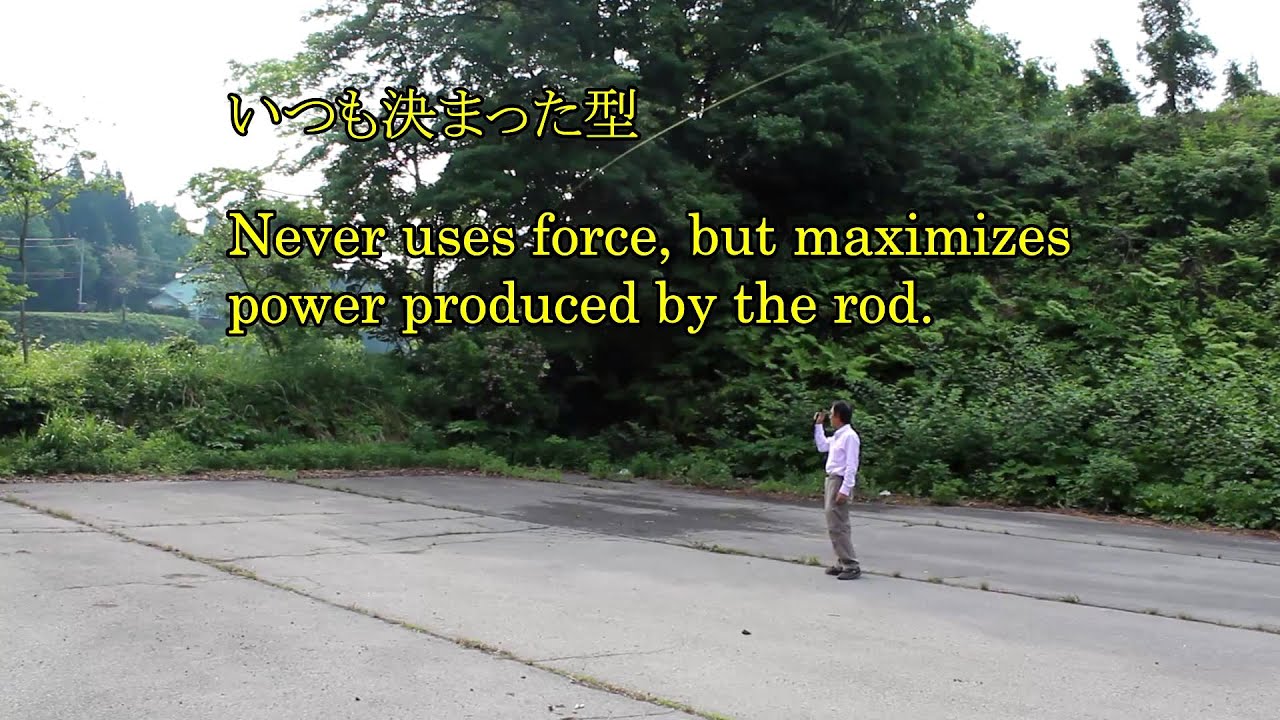
With a line that long if you look carefully - you will see the end of the line is a above and a little forward of he head, still moving rearward - when his arm starts the forward casting stroke. I think you can see the same thing when lines approach 8 m in length.
[ In the video comments writes that with a tippet of 1.2 meters attached the opposite bank of a main stream river - 17 meters distance - can be reached]
I have found casting with this method works well for me to cast lines of ~ 5m or longer.
{once in a great while I will try fishing with a 6m or 7 m line, not often. Just for casting practice I have tried to cast lines of 8m, 9m, 10m. Never could cast a 10m line with a success rate = > 10%. - got ok with 8m. But I believe just trying to do it improved my casting of shorter long lines - 5m is about the usual limit I fish with, 4.5 m more often}
Anyway, try casting from shoulder pivot. Tomahawk Chop. Not much wrist flip, if any. Don’t start the forward cast with hard acceleration, leave that for the end of the casting stroke. Generally I find it slows down my rhythm, and the line rolls out nicely. Fly first landing or close to it a high percentage of my cast.
I realize this is an old thread and so I’m running the risk of people’s ire by jumping into something so long dormant, but there’s been so little activity here I figure I’d risk it.
I just want to say what gem this thread (and honestly the whole community) is – thanks to arieger for starting it. It’s got everything from debate around defining tenkara, to discussion of social media vs IRL, to actual in-thread instruction! Along those lines, I really appreciate everything from Brian_Miller and Gressak, especially, for their conversation (Brian calls it a “digression” but I don’t think it is) about fishing in salt – a topic I’ve been very curious about.
As a fairly new fisher (Tenkara or otherwise) in the Seattle area (maybe 3-4 years?), I’ve been slowly ramping up and getting comfortable chasing tiny fish in my localish mountain streams. That said, I’ve also been wanting to try SRC fly fishing in Puget Sound for pretty much forever, so this “long line” thread caught my eye.
I live in Seattle (not a SRC hotbed, but they exist in some numbers) and also spend some time in South Puget Sound and would love to bring my Hellbender and hook up a SRC (or anything, really) down there – maybe from a paddleboard even. It seems so possible and logical and “simple.”
But he posts from David_Miller and Gressak have helped me realize that while fixed-line salt may be a fun exercise, it’s probably not the most effective strategy for SRC in Puget Sound. And if I want to get past the “dabble” period, I might even have to add a 6-weight Western fly rod to the mix (and learn how to cast/fish it, lol). And that’s OK.
For now, I’ll keep reading and practicing – tenkara in the mountains in the summer, while occasionally trying this salt thing during the winter. My closest beach is Shilshole/Elliot Bay – basically the water you see in a picture of Seattle – and while it’s not a great fly fishery and maybe not even the right technique, it’s still a nice place to stand in the water, throw some flies, and contemplate life.
Thanks to everyone for all the great discussion, and here’s to hoping it continues in 2026 and beyond!
Welcome to the forum!
@tallkara just as a back history. @Peder (peder rude) was this founder of this forum, but now another member @cc121 (chris cameron) is the owner. I am thankful for both gentlemen and this forum.
This vitual venue has harbored civilized discussion… which I feel has a lot value these days.
I would not discourage you from trying fixed line in the salt, think the outcome depends on the species targeted. Fishing the salt is a bit of an edge case… so there may be insuffient info on tactics and feasibility. Best to pave our own way and come to our own decisions on the approach. That is the fun part.
Anything goes, even tuniods are and have been targeted commercially with fixed line for a long time.
If I recall correctly, I may have noted that fixed line in the salt and long line fixed line are not practical for me. To expand on this, practical and fun/entertaining are 2 different things. Not everything we do has to be practical or efficient to enjoy it. I fish a flyrod in the salt, but even it is not as practical or efficient as spinning gear… but it sure is challenging, fun, and entertaining for me.
I hope that helps give better context.
Thanks very much for the reply. I’ve been here for almost a couple years now – long enough to have seen the transition from @Peder to @cc121 (thanks to both for everything!) – but have been a bit afraid to engage much. So much great info, but such a serious, intimidating lot! That’s more of a me problem than the forum, but I thought I’d put it out there in case there are some other lurkers like me. This place isn’t that scary!
I really appreciate the idea that not everything we do has to be practical or efficient. To my wife’s chagrin, that’s how I lead (too) much of my life. 
Seriously, the main reason I got into Tenkara (and really my first foray into fishing since childhood) is the simplicity factor. I had always wanted to fly fish but didn’t know where to start and I knew my ADHD brain would jump too deeply into the western flyfishing quagmire and probably explode the whole attempt. Luckily tenkara gave me a path back into fishing and I found I really, really enjoy it – both the catching of fish and, maybe moreso, the act of fishing.
At this point, I think I’ve decoded enough of the mysteries (or what I saw as mysteries) around fly fishing to determine I’d probably enjoy tackling western style on occasion, too. I doubt it will replace tenkara for me (a woodsy bike ride with a tenkara rod tucked away in my handlebar bag for some impromtu fishing is as good as it gets for me), but it will be a fun challenge to take on – especially, I think, in the salt.
Thanks for the encouragement!
Welcome to the forum Tim K! I live down in the Marine Area 13 - South Sound area.
This is a “do-over” revision of an earlier post I made. I found the article I had referred in that post. The author is having success with fishing T-rods in the salt 200 miles away from us. Reviewing the article and a follow-up email exchange we had again has *changed some of my conclusions, and clarified others . So I figured I’d just delete my previous post and start over…
There are huge differences between fishing for SRC in streams and saltwater.
If I were to rate them, #1 would be locating the fish in saltwater.
SRC are anadromous meaning they are found in both freshwater and saltwater. A few years ago it was thought that smolts would migrate into saltwater in the spring and stay there until the fall when they would return to their natal stream to spawn, and repeat the cycle in the spring. But SRC are not a commercial “food” fish like salmon so money wasn’t being allocated to study them like salmon. Recent research by the Coastal Cutthroat Coalition
has shown that like an also recent discovery with Steelhead - Rainbow Trout, some PIT tagged Coastal Cutthroat coming out of the same redds will be anadromous Sea Run Cutthroat migrating into saltwater, and some are fluvial; staying within river systems and only moving within the river. It’s also been found that the anadromous fish seem to stay in the estuaries within about 5 miles of their natal streams and some have been caught multiple times off the same beach. To make things even more confusing, SRC will move in and out of their natal streams more than once during the year (some fish 3+ times). What this all adds up to is, the fish don’t have to be there so they can be a challenge to locate, but once located you can probably find them there again. But where, when, and why?
*The angler has to figure out what brings the SRC to that location. It’s obviously food; salmon smolts, smelt, sculpins, shrimp, squid, sand lance… but where, when, and why are they there?? SRC aren’t going to waste a lot of energy going after single fish. They are going after schools of baitfish that are being concentrated by tidal currents, structure, and even seals or other predators.
I like to study and photograph beaches at low tide to locate the structure and check them out during flood and ebb tides to see what I can find hanging out near the structure.
*Also, some beaches are more likely to possibly have fish present, AND be easier to fish on a flood tide, and some on an ebb.
*Tidal currents are generally slower than currents in streams that help with fixed line fly presentation and manipulation and I don’t see as many “rip tides/currents” as I do “seams” in streams where I find fish within my casting distance, which segues to…
*#2 Casting Distance… Just like in streams the saltwater beach angler should fish the close water first before blundering out from shore and spooking everything (baitfish & the fish we are trying to catch) nearby. But in open water on low gradient beaches during both the flood or ebb, the water is always pushing into shore which means after a 20’ cast there is virtually always less time my fly can be in the water before I have to recast than with being able to “shoot” a longer cast. A fly in the air isn’t going to catch fish.
While I’ve had SRC follow a shrimp, squid, or baitfish pattern almost to my feet, and have hooked them in calf deep water, most often it’s after a 60’ to 70’ cast where they probably saw it and followed before eating it, or seeing me and scooting back to deeper water. *And during that longer retrieve I have the ability to use effective presentations that I cannot do as well with a shorter cast on a fixed line rod such as
as long fast strips to mimic a frightened baitfish… Also I can’t make those long casts with a fixed line rod, so I am limiting how many fish are going to get a look at my fly.
*And finally, I’m not very good at casting a fixed fluoro line into a stiff onshore wind.
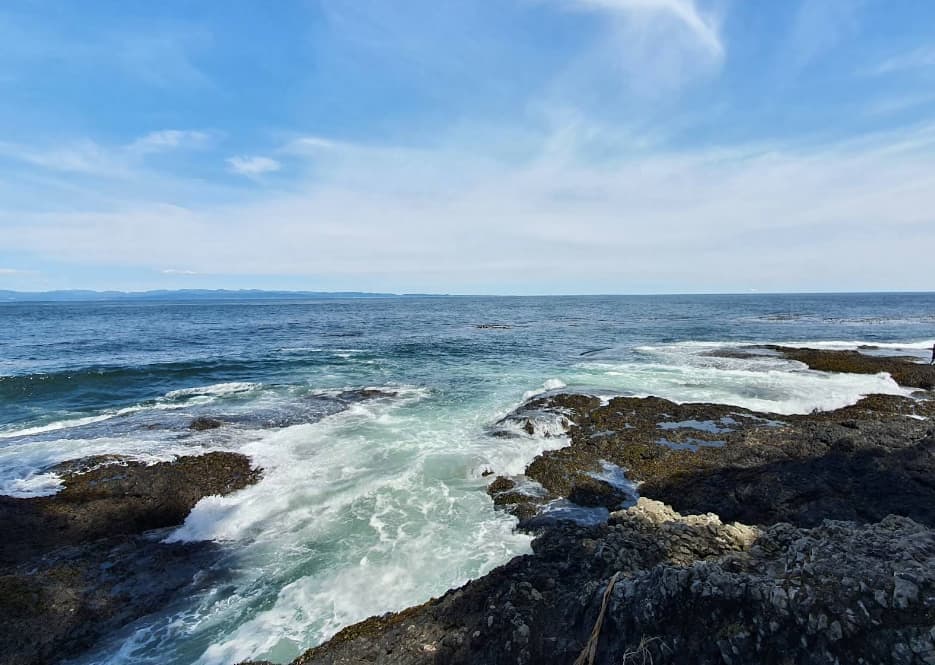
*This all has led me to think that fishing off a steep rocky shore directly into deep water, kinda like this beach west of PA where they could be reached using a fixed line rod making a 20 ft cast might be more effective.
But I don’t know of too many beaches like that in the Sound. Most are like saltwater “flats” with small channels and structure formed by creeks, streams, tidal currents… There’s also weed beds, sand lance flats and oyster beds…
*I finally found an article I had read by an angler in BC about using a T-Rod for Sea Run Cutthroat (SRC), and *he does fish off low gradient beaches similar to what we have in the Sound.
I also had emailed him and asked about what line he uses. He graciously responded saying “The only line that I have on my Tenkara rods are traditional furled lines with about a six-foot tippet of four-pound test fluorocarbon.” That, and I assume his lines are roughly the length of the rod explains how he is able to cast into the wind.
*As I mentioned in an earlier post(s) above, I tried a 10-meter tapered line with a 5.4-meter Keiryu rod to get a 35’ cast. With practice it worked on a lawn at the park but not so well into an onshore breeze without piling up short. Plus that rod has a lot of wind resistance. And not being able to shoot line really limits where you can actually fish on shore against a high bank when carrying that much line in the air at the end of the 5.3-meter rod. I tried fishing the same beach bringing along both the Keiryu rod and my 9 1/2’ 6 weight beach rod and using the same fly. I was only able to hook and land fish with the western rod.
If I’m going to take the time and effort to learn all this stuff, I’d like my time on the beach to be productive. **But Rory Glennie is doing it 233 miles away on similar low gradient saltwater beaches in BC. The cost of a 4-meter furled line to use with my 3.9 and 4-meter rods is low enough I could give it another try. It will take a real leap of faith to believe that in the endless expanse of clear water on a low gradient saltwater beach, fish will come close enough to see, and want to eat my fly.
*Maybe we should meet up and give it a try!
Wow, this is really fantastic, Brian. Thank you!. I probably need to process all this a bit more but for now I have a few couple comments:
I’ve done some initial learning but have much to do – I’ve been reading about SRCs via a few “local” books (Bruce Ferguson, Chester Allen, Steve Raymond, etc). I follow the Coast Cutthroat Coalition on Facebook, but need to look more into their studies/info. And I have Estuarine Fixed-Line Fly Fishing article bookmarked – that’s actually what got me thinking that maybe tenkara + SRC was possible around here.
When I bought my Hellbender (3.9m at max zoom), I also grabbed their “18’ power taper furled line” they say is designed for casting in the wind) and a16’ floating line. I’ve tried casting both of these in Elliot Bay in minor onshore breeze and found the furled line was easier – even though it’s longer. I also tried them down in Case Inlet (the “river” between Joemma and the YMCA camp if you know the area) but I had the wind at my back that day. No fish, but I felt like a hero casting that day! I was going to rig up a longer line to try out, but took a fall before I got there and called it a day. I’ve since made up a ~7m line from some 65# braided PE line just to have in the bag of tricks. l need to get back and give it a go, but maybe I should try a 4m furled line while I’m at it. Because honestly, how often do I get an offshore wind? (and honestly, I wonder what the heck will happen if I try to land a SRC with ~30’ of line).
FWIW, I camp on occasion near PA – that beach you mention looks like the one near the campground. I love to tidepool there but for some reason haven’t thought about trying to fish it.
At any rate, these SRCs seem a wily fish – everything I’ve read agrees with your assessment that first you need to find them. That’s a little harder when I’m up here in Seattle and the SRC population is more to the south. All of those authors say there’s no substitute for hours haunting beaches to get some idea of where the fish will be in various conditions/tides.
I tend to be really good at research and less so about putting it into practice, lol. So all of this is going to take some effort and hours and driving. Ugh, I hate driving. Though luckily I’m getting a bit closer to retirement and maybe can slowly/steadily lay some groundwork without it feel like I’m driving over the narrows every day.
I keep coming back to casting distance – the ability to get the line out there, and then have the retrieve time + action to make up for the lack of current (vs. river) makes perfect sense.T hough I also agree with you – if it works for Rory, why not us? Again, beach profile should play into it. Surely that PA beach has different requirements than a gradually sloping Puget Sound beach? And it logically seems like tenkara could be easier on a higher gradient shore. Or maybe not. I dunno. 
Luckily I’m still such a bad fisher (and love being on the water so much) that I hardly notice when I’m getting skunked. I’m going to have to try that PA beach with the tenkara rod next time I’m out there, because why not?
I still think picking up a 6wt and learning to use it isn’t the worst idea. At least that way I can practice my “long” casting into the wind while I’m stalking potential beaches for both SRCs and the possibility of a “tenkarable” SRC beach, allowing me to stretch my days rather than packing it in when it’s too windy to cast!
Thanks for all your help. I’d love to stay in touch and maybe meet up IRL some time!
I think I got blanked on my 1st Tenkara trip in May 2018 ~20 river miles up a South Sound stream. It is considered habitat for winter Chinook (Kings), spring-summer Coho, and SRC. Two weeks later I landed 3 fish a mile upriver from that location. The 2nd fish was a Coastal Cutthroat larger than many SRC I encounter in the Sound. There is a good possibility it was a sea run fish.
But 30’ of line… without a reel I would have to repeatedly pull the line in “hand over hand” to the net. That eliminates the T-rod from controlling the fish, and could get real awkward if the fish decided to take off again when it gets close. Coho do that. Plus I just couldn’t cast my tapered line into the wind either. Naaah, I’d rather not use a 30’ line.
A very good point (and a cool story!).