I’m curious about why you say supple - I tend to prefer a stiffer line
I used to want supple but have gone the opposite - thinking about drape
I’m curious about why you say supple - I tend to prefer a stiffer line
I used to want supple but have gone the opposite - thinking about drape
I’m no physics major, but when it comes to drape I think a supple line would drape less. Line weight is our drape force, with water tension being our anti drape.
A supple line as it moves in the current would require less force/tension to straighten out. I think a stiff line would influence drag more as you tighten the line.
I doubt there’s enough difference to matter. The suppleness trait is more desired for casting for controlling loops. Specifically when doing more advanced casting than typical straight back, straight forward casts.
given the same density and with suppleness being the only difference a stiffer line ought to drape less - imagine the extreme - that being a totally rigid line
I reckon I always figure that it’s basically tippet in the water - so not sure about the moving with the current thing - but that may be just me not understanding what you mean
I never have the opportunity for a “typical” cast in my normal streams - but still prefer a stiffer line as a support mechanism for casting in tight conditions - within reason of course
Also I do like furled lines from time to time - and I always thought I liked the most supple - but over time realized that my casting and fishing was better with stiffer lines (and drape was less)
variety is the spice of life though and I prefer to hear different ways of fishing than see one way touted as the “best”
and I’m always open to revisions in my ideas - perhaps this is worth some serious side by sides next time out
though I often have the idea to do “serious” testing when in the stream and often never get around to it
My Tenkara is always evolving. I think it’s important to try new things to have a complete understanding of the gear we use. The gear doesn’t make us better, only how we use it knowing it’s strengths and weaknesses does.
I could be way off on my thoughts. It’s merely the current path I’m on. I came from the previous thought process that stiffer is better, but now I’m testing the other side of things.
Early on, I didn’t experiment much. I used a rod and level line and that was good enough for me. But I’m trying to branch out a little bit. Have some fun beyond just trying to catch fish.
I understand that - I mess around with different lines almost every time I head out. Just went fishing with Varivas AIRS floating shooting line. I tried the 36lb but I need to try the 24lb. 36 is probably okay for bass bugs and such but the 24 may be more suitable as a general floating line
I agree with Anthony. I played around with nylon lines several years ago and decided I liked stiffer better than softer. For a while I made and sold hand tied tapered nylon lines and the softer lines just wouldn’t turn over as well as the stiffer ones. The same physics are why fly fishing nylon hand tied leaders use stiff nylon in the butt section. I liked fluorocarbon better than nylon and before long gave up on the nylon - not because I couldn’t cast it, but because I could cast a thinner, denser fluorocarbon line so much better. Even for the same line weight, and thus the same “draping force” (gravitational effect), the fluorocarbon casts better because of the smaller cross section and thus reduced wind resistance.
Not having used nylon but observing video and also have used spectra I sort of feel the reduces sag statement is misleading. Softer lines may sag more than rigid line but will staighten with less force than rigid.
Illustrations are never perfect, but one thing I notice is that it is nearly impossible to get all the coil out of flouro level line. There is always some…and that line is often like a spring…and has its own resistance. A soft line to go a step further than nylon…and use spectra as an example, has far less memory, less stretch, and requires far less force to straighten out. Like lets say the force of small or slow currents. The force of the water may be enough to overcome the sag in nylon, but not in flouro level line.
This thread…has me thinking on goofing with spectra a little. I have a lot of that stuff. Never tried to cast it.
Regarding super light lines and fast water.
This observation may slip into the nerdy, and may not be 100% factual.
Near fast water, especially cold water, I always feel air flow. Like…in transit to a spot or between spots…the air is dead. Pull up to a river and instant feeling of air circulation. Makes sense…probably the result of variant temperatures meeting and create thermal eddies(air movement).
I could see how a lighter more supple line could resist sag and stay aloft it the air movement were enough to overcome its rigidity.
There is also whatever resistance provided by the kebari in the water (and what the water is doing) which allows you to “stretch out” a lighter line while needing less “oppositional force” from the water and fly.
The slower turnover/delivery aspect is really interesting on spooky water too I think (on its day).
Other times, the “zingy” casting of the level fluoro feels like the way forward.
Horses for courses and all that 
So somebody was kind enough to share samples of the Varivas nylon lines with me … I finally got out in the back yard to do some casting
My setup was just the line - no tippet or fly - so take that for what it’s worth
I was using 7meters and casting with my 3RT Confluence rod in both the 10.5 and 12 ft positions
Here’s my backyard casting thoughts
The Varivas Vermax 4 gou was plain easy to cast at 7 meters - no problem at all
Between the Black Snapper Special and Black Snapper 3 gou lines - I found the regular Black Snapper easier to cast than the Black Snapper Special
even at 7m (which is much longer than I’d normally fish with) they we both castable - with some cast adjustments, timing is crucial of course and I found a slight lift of the rod tip as the line was just about unrolled on the delivery helped to get the line tip around just a but easier
These lines are fairly stiff by my judgement compared to something like regular old Stren fishing line and I suspect that makes them much easier to cast than said Stren (I’ve been messing about with 8# Stren for casting practice)
The other advantage is that visibility - the lines were very visible
With the clear Stren it is very hard to make casting adjustments because you just can’t see what the line is doing
I have not fished with them yet - so the question of how do they compare to FC lines for my fishing and what if any are the real on-stream advantages remains unanswered
After speaking to a competition angler (who is currently on Team USA) just yesterday I’m not convinced that that the stiffness is quite the advantage that I may have believed … I need to learn more about his thoughts on that
But based on yard casting of 7meter lines - I’m pretty confident that they pose no real challenge to experienced casters (regardless of rod) that are willing and able to make adjustments - and if they offer the advantage of more line off of the water - maybe they’ll make their way into my kit
That sounds encouraging.
I am curious about skipping the tippet and fly. The couple times I have casted lines without them, the running lines seemed to be much easier to cast. I would not consider myself and “experienced caster” though and my recollection might be fuzzy.
If you do fish the lines in the field, I would dig hearing on how they perform.
So my recent experience with the 8# Stren nylon was with fly and tippet - and it really depends on the aerodynamic quality of the fly - a sparse soft hackled fly on a heavy-ish hook actually made casting easier than with just the line alone - because the weight of the fly adds significantly to the total weight of the rig - a more highly wind resistant fly is going to be tougher to lay out as always
Thanks for the update.
went out with the lines again - 7m but this time added 3ft tippet and kebari. Same results - as without the tippet and fly- fairly easy casting. the Snapper line is a completely different animal than say a regular nylon spinning line that you get of the same diameter -
For me the key to the longer nylon lines is a very slight lifting of the rod at the end - not drastic at all - but the little lift of the rod tip just makes that nylon turn right over at the end of the cast - that’s why the more visible line makes it easier for me - I can see the point to lift the rod near the end of the cast
That’s the exact same thing that I experience too. Makes all the difference for that last foot (30cm) of tippet to turn over. Understanding that also really helped improve my casting with the fluorocarbon line too.
Lifting the rod tip just slightly at the end of the casting stroke is not a bad idea for 3.6-4.5m fluorocarbon lines as well. If you watch the videos carefully, you will notice it at the end of many of Tenkara no Oni’s casts. It definitely helps the fly land first. I learned from Rob Worthing at this year’s Oni School that if your lift is not straight up you can lay the little bit of tippet that falls to the water either upstream or downstream of the fly, which can affect the depth of the drift and can also lay the tippet in the same current seam as the fly when you are fishing a narrow seam.
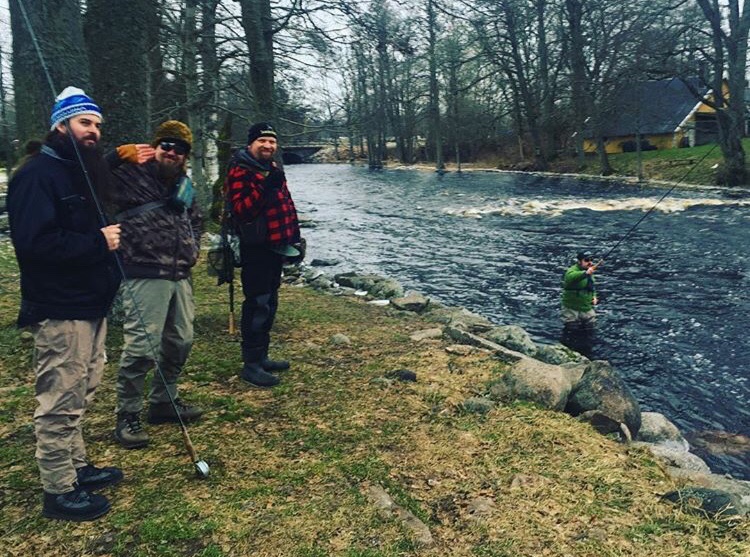
Peder was very kind to send me three different nylon levellines in 6m length. And today I met with some friends by a river in the south. I only had time to test the Black Snapper, I chose that to test for the day since out of three that was the preferred by the sender.
It worked really well, and I will use it again for sure!
I also think I sold another Ito for TUSA.  That rod keeps impressing and it handled the nylon just fine.
Looks like a nice day to be out.
It was, but wading deeper than I do in the photo above was not recommended. Not that I’m planning on having kids anyway, but still…
Hahaha. Wise choice on both fronts.