Welcome to the forum Tim K! I live down in the Marine Area 13 - South Sound area.
This is a “do-over” revision of an earlier post I made. I found the article I had referred in that post. The author is having success with fishing T-rods in the salt 200 miles away from us. Reviewing the article and a follow-up email exchange we had again has *changed some of my conclusions, and clarified others . So I figured I’d just delete my previous post and start over…
There are huge differences between fishing for SRC in streams and saltwater.
If I were to rate them, #1 would be locating the fish in saltwater.
SRC are anadromous meaning they are found in both freshwater and saltwater. A few years ago it was thought that smolts would migrate into saltwater in the spring and stay there until the fall when they would return to their natal stream to spawn, and repeat the cycle in the spring. But SRC are not a commercial “food” fish like salmon so money wasn’t being allocated to study them like salmon. Recent research by the Coastal Cutthroat Coalition
has shown that like an also recent discovery with Steelhead - Rainbow Trout, some PIT tagged Coastal Cutthroat coming out of the same redds will be anadromous Sea Run Cutthroat migrating into saltwater, and some are fluvial; staying within river systems and only moving within the river. It’s also been found that the anadromous fish seem to stay in the estuaries within about 5 miles of their natal streams and some have been caught multiple times off the same beach. To make things even more confusing, SRC will move in and out of their natal streams more than once during the year (some fish 3+ times). What this all adds up to is, the fish don’t have to be there so they can be a challenge to locate, but once located you can probably find them there again. But where, when, and why?
*The angler has to figure out what brings the SRC to that location. It’s obviously food; salmon smolts, smelt, sculpins, shrimp, squid, sand lance… but where, when, and why are they there?? SRC aren’t going to waste a lot of energy going after single fish. They are going after schools of baitfish that are being concentrated by tidal currents, structure, and even seals or other predators.
I like to study and photograph beaches at low tide to locate the structure and check them out during flood and ebb tides to see what I can find hanging out near the structure.
*Also, some beaches are more likely to possibly have fish present, AND be easier to fish on a flood tide, and some on an ebb.
*Tidal currents are generally slower than currents in streams that help with fixed line fly presentation and manipulation and I don’t see as many “rip tides/currents” as I do “seams” in streams where I find fish within my casting distance, which segues to…
*#2 Casting Distance… Just like in streams the saltwater beach angler should fish the close water first before blundering out from shore and spooking everything (baitfish & the fish we are trying to catch) nearby. But in open water on low gradient beaches during both the flood or ebb, the water is always pushing into shore which means after a 20’ cast there is virtually always less time my fly can be in the water before I have to recast than with being able to “shoot” a longer cast. A fly in the air isn’t going to catch fish.
While I’ve had SRC follow a shrimp, squid, or baitfish pattern almost to my feet, and have hooked them in calf deep water, most often it’s after a 60’ to 70’ cast where they probably saw it and followed before eating it, or seeing me and scooting back to deeper water. *And during that longer retrieve I have the ability to use effective presentations that I cannot do as well with a shorter cast on a fixed line rod such as
as long fast strips to mimic a frightened baitfish… Also I can’t make those long casts with a fixed line rod, so I am limiting how many fish are going to get a look at my fly.
*And finally, I’m not very good at casting a fixed fluoro line into a stiff onshore wind.
*This all has led me to think that fishing off a steep rocky shore directly into deep water, kinda like this beach west of PA where they could be reached using a fixed line rod making a 20 ft cast might be more effective.
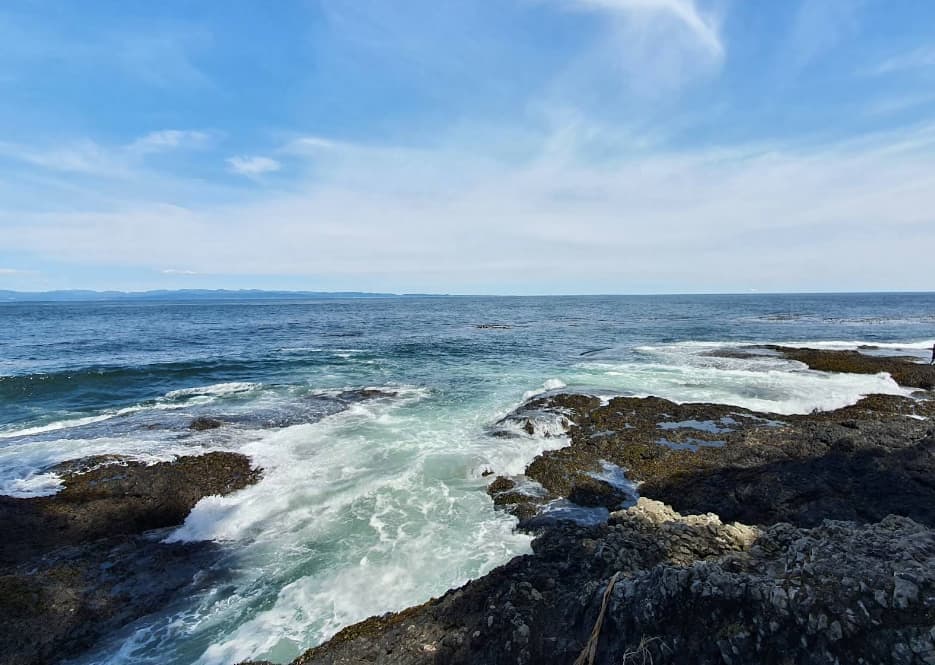
But I don’t know of too many beaches like that in the Sound. Most are like saltwater “flats” with small channels and structure formed by creeks, streams, tidal currents… There’s also weed beds, sand lance flats and oyster beds…
*I finally found an article I had read by an angler in BC about using a T-Rod for Sea Run Cutthroat (SRC), and *he does fish off low gradient beaches similar to what we have in the Sound.
I also had emailed him and asked about what line he uses. He graciously responded saying “The only line that I have on my Tenkara rods are traditional furled lines with about a six-foot tippet of four-pound test fluorocarbon.” That, and I assume his lines are roughly the length of the rod explains how he is able to cast into the wind.
*As I mentioned in an earlier post(s) above, I tried a 10-meter tapered line with a 5.4-meter Keiryu rod to get a 35’ cast. With practice it worked on a lawn at the park but not so well into an onshore breeze without piling up short. Plus that rod has a lot of wind resistance. And not being able to shoot line really limits where you can actually fish on shore against a high bank when carrying that much line in the air at the end of the 5.3-meter rod. I tried fishing the same beach bringing along both the Keiryu rod and my 9 1/2’ 6 weight beach rod and using the same fly. I was only able to hook and land fish with the western rod.
If I’m going to take the time and effort to learn all this stuff, I’d like my time on the beach to be productive. **But Rory Glennie is doing it 233 miles away on similar low gradient saltwater beaches in BC. The cost of a 4-meter furled line to use with my 3.9 and 4-meter rods is low enough I could give it another try. It will take a real leap of faith to believe that in the endless expanse of clear water on a low gradient saltwater beach, fish will come close enough to see, and want to eat my fly.
*Maybe we should meet up and give it a try!